Raytheon announced that it is raising the quarterly dividend to 24 cents a share. Last year it was 22 cents and for several years before that it was 20 cents per share per quarter. The new rate pushes the dividend yield over 2% at current prices, which isn't great on its own. But the new trend toward increasing the dividend is very encouraging. One the reasons I feel good about Canon, is that every 6 months management raises the dividend a notch. Giving out cash is not only very good for shareholders, it signals that management is comfortable with the future of the business.
Thursday, March 30, 2006


SEC webpage hack
First, I'm using definition 3. a., not 3. b.
Easily the most difficult part of investing in reserve split cashout situations is finding the SEC filing. Companies that intend to "go private" initially file a SC 13E3 ("Going private transaction by certain issuers"). Later they might file a SC 13E3/A (" [Amend]Going private transaction by certain issuers"). Often those filings refer to either a SC TO-T ("Tender offer statement by Third Party") or a PRER14A ("Preliminary Proxy Soliciting materials") which contain the details of the transaction. Normally, companies that are merging or buying out all outstanding shares are less interesting than reverse splits. All of this takes some digging.
Fortunately, the SEC offers an interface to recent filings, but the menu only goes back five business days. But if you change the URL, you can see filings any number of days old. Today's 13E3 filings are: http://sec.gov/cgi-bin/current.pl?q1=0&q2=0&q3=SC+13E3. The ones filed two weeks ago are: http://sec.gov/cgi-bin/current.pl?q1=9&q2=0&q3=SC+13E3.
The next step is to search through the filings for good or potentially good deals. Since the same companies might amend their 13E3 filings dozens of times, it's good to take notes so that you don't duplicate research.
Wednesday, March 29, 2006
Major Automotive transaction completed
I bought Major Automotive on February 28 for $1.75 a share and received $1.90 a share this morning. After accounting for commission (on the purchase), I made $129.90 in 29 days. If I could make this transaction on a continual basis, I'd earn 144% a year.
Of course, the problem is that there aren't enough of these situations and they aren't big enough to constantly do them on a large scale. Which is just as well for me, since if they were, the opportunities would disappear.
Wednesday, March 08, 2006
Major Automotive goes private
I'm one step closer to collecting a quick $128 profit according to this 8-K filing.
Friday, March 03, 2006
USATODAY.com - Oracle? Buy, sell or snooze?
I think Oracle might be undervalued again. As you can guess from the title USATODAY.com - Oracle? Buy, sell or snooze? suggests that Oracle is sleepy stock that isn't worth pursuing. That may be (certainly it has been true for last year or so). Let's go over Matt Krantz's arguments step by step.
"Step 1: Measure the stock's risk and reward."
Beta is the measure of how a stock's price moves in comparision with the overall market. According to Oracle's beta, the stock is extremely risky. (It also suggests that Oracle isn't a sleepy stock.) This chart illistrates the risk.
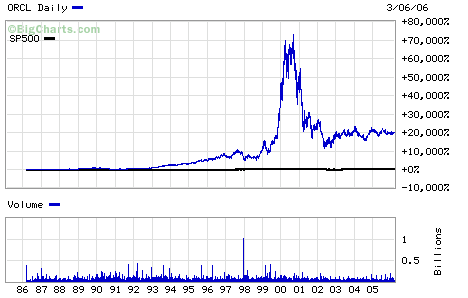
I think most people would be happy with this sort of risk, but it's obvious that if you bought at the wrong time (during 2000) you would have lost a ton of money. On the other hand, if you bought at some of the right times (not during 2000), odds are good you would have come out ok. (I originally bought in 2002, so I'm feeling pretty good about Oracle right now.) If you know how to evaluate Oracle, high beta is actually a plus.
"Step 2: Examine the stock's earnings multiple."
According to the article, Oracle looks pretty good from the P/E ratio standpoint. "But even this should give investors pause, because it shows that Oracle's profitability (defined by return on equity) also has been declining sharply. This is not an encouraging sign." As a matter of fact, since its peak in 2000, ROE has fallen from 97.5% to 26.6%. For comparision, Microsoft's ROE peaked in 1997 at 35.3% and fell to 10.9% for 2004. It's now at 25.5%—a bit less than Oracle. Let's just say, I'm not discouraged.
"Step 3: Calculate the company's value using forecasted future cash flows."
Using the discount cash flow tool at Smartmoney.com I find that is worth somewhere between $11.50 (if you take beta into account) and $13.18. The key assumption is a 12.2% growth rate over the next five years. I think this growth rate is possible, even likely, but I'll talk about why in a moment. Since Oracle is currently priced around $12.80, I'd say it's overpriced if you think beta is a good proxy for risk and fairly priced if you don't.
"Step 4: Check the USA TODAY Stock Meter score."
To be honest, I don't have any idea what this adds to the argument. I tried out a few other stocks to see what their "USA TODAY Stock Meter score" might be, and most companies seem to be in the 3.0 region. I guess I'm not sure what it tries to measure.
So the real question is will the aquistions of PeopleSoft and Siebel provide enough extra earnings to make Oracle's current price a bargain? I think Oracle paid too much for that to happen from cost-cutting alone. As a shareholder, I'm betting that there will be more opportunities for Oracle to sell expensive bundles to companies as a result of these aquisitions. I see Oracle in much the same situation that Microsoft was in around 10 years ago.
Tuesday, February 28, 2006
Why I bought Major Automotive
Today I bought 999 shares of Major Automotive at $1.75 a share. Nearly 100% of the reason may be found in a recent SEC filing. I haven't had many good ideas for long-term investments, so I thought I'd try out an idea for a short-term investment I'd recently read about. The basic idea is to invest in shares that will be cashed out in order for the company to go private.
My hurdle rate for short-term investments is the 4-5% that I will be getting from the money market account my cash will be invested in over the next few months. If I don't expect to earn that rate, I'm better off staying in cash. The Major Automotive proxy says that anyone holding fewer than 1,000 shares will receive $1.90 in cash if the deal is approved. So I stand to receive $1,890.10 for my 999 shares. Including commission ($19.95), I spent $1768.20 to buy my shares, which works out to a $129.90 gain. Obviously, this isn't going to be a huge investment in absolute terms, but it is a little over 7% rate of return.
The one thing I don't know, however, is how long it will be before I get the cash. If the deal is approved at the annual meeting on March 3, and the paperwork takes until the end of the month, I'll be holding the shares for about 1/12 of the year. On an annualized basis, my return (130%) blows away the hurdle rate. Of course, it could take longer than that. But as long as it doesn't become a long-term investment, I'm in good shape.
Monday, February 06, 2006
Why I bought Berkshire Hathaway
Actually the question might be why I didn't buy Berkshire Hathaway earlier. After all Mr. Buffett's annual letters taught me how to value businesses and inspired me to try my hand at investing in individual stocks. The basic insurance business is one of the all-time great business models. Shortly after my wife started her Pampered Chef business, Berkshire bought the company. I've known about GEICO since long before it advertised in earnest. And of course, I'm a big fan of Dairy Queen and See's Candy.
But the strange array of assets that make up the company is a bit hard to value. Thankfully other people are interested in that question as well. A little while ago, I discovered the Berkshire Hathaway Intrinsivaluator. Of course, I've substituted a complicated set of models that I don't completely understand for a business that was complicated, but explained in relatively simple terms by Mr. Buffett. But the nice thing about the models is that we have an objective judgment that extends back through the years.
Currently, the models suggest that the shares are fairly cheap, but not at "cigar butt" level. And going back in time, the intrinsic value for the various models seems to grow by fits and starts. But the price jumps all over the place—far too cheap in 1981, over valued in 1996, and everywhere in between. Lots of times, the market seems to have a handle on the value as calculated by the models.
The real problem with an accurate evaluation, is the nature of the insurance contracts Berkshire writes. Someday there will be one or more super-catastrophes that could threaten the solvency of Berkshire Hathaway if it became undisciplined. In his 2002 letter, Mr. Buffett said, "Had Gen Re remained independent, the World Trade Center attack alone would have threatened the company's existence," in reference to a recently acquired reinsurance subsidiary. But unless and until such a disaster occurs, an insurance company can use the premiums it hasn't yet needed to pay claims (called float) to invest as it sees fit.
In some ways, investing in Berkshire Hathaway is like investing in a large and sucessful mutual fund. On the one hand, the past returns look outstanding. On the other, it becomes harder and harder to find good investments for the cash that keeps rolling in. Unlike a fund manager, Warren Buffett isn't restricted by investment style or SEC restrictions on funds. He may buy whole companies—even privately held companies. And so far, he's managed to get a good return.
Monday, January 09, 2006
The purpose of R&D
The companies I invest in tend to have a high rate of R&D expenses. I suppose some of that is rub-off from where I work. I'd like to have a part in developing cool new technology like fuel cells.
But creating new products is only part of what I look for in a company's R&D. I also would like to see research that makes existing products better and cheaper to manufacture. Not only is it lower risk, it also is harder for other companies to copy. This sort of research can lead to long-term competative advantages.
Why I'm buying the PIMCO Total Return bond fund
For the past year or so, I've been concerned about my original strategy of investing heavily in an S&P 500 index fund. For one thing, I've been investing in active funds that beat their index over the course of several years. Also, it seems like the index is biased toward expensive stocks. I still like the low fees, but I'm concerned that the indexing strategy will be costly if there is a recession—especially since P/E ratios are so high.
Recently, the yield curve inverted slightly. So I decided to move about half my index fund "ballast" into a bond fund.
I only considered funds with expense ratios < 0.5% and manager tenure of 10 years or more. Here are the returns for all candidates in my 401(k) plan:
Investment Name   1 Yr 3 Yr 5 Yr 10 Yr LOF
PIMCO Total Return Inst CL 2.58% 4.89% 6.84% 6.98% 8.54%
PIMCO Total Return is the largest of all bond funds in terms of net assets. For a stock fund, that would be a huge negative, but a bond fund should scale better. Costs are everything in bond funds, since there is little room to differentiate on the basis of picking individual bonds. Unlike stock funds, size doesn't lock bond funds out of the best investments.
Thursday, November 03, 2005
Syntax versus semantics
Recently I had someone contribute some coding changes for my project at work. I had made it clear that I wanted to know all of the things he had changed. He didn't seem willing to do that and for mostly political reasons, I didn't feel I could compel him to give a complete report. So I settled on a compromise: he'd give me a list of "interface" changes.
My idea behind that suggestion was that if he fixed a bug or reformatted some code, I really didn't care too much. But if he changed the way a part of the system operates, I'd like to know the general reasons why. A couple of weeks later, he checked in his code and reported the changes in the interface as he saw it and I started to test the code.
Not surprisingly, something broke. He's an outstanding programmer, but with a large system it isn't easy to make a large number of changes that work right out of the gate in every situation. After digging around for a few hours, I finally discovered the offending code. He had replaced an entire source file with a check-in comment something like, "Replaced with working version." His version changed the semantics of a function call in a way that broke a program in a non-obvious way.
Now, that sort of change is exactly the sort of thing I was fishing for when I asked about "interface" changes. His response was that since the function signature hadn't changed, the interface hadn't changed. And he's correct if we had been talking about syntax. But I don't care about the syntax interface. A compiler can tell me if that changed. I needed to know about semantic changes, which are much more difficult to discover.
Thursday, October 06, 2005
The price of foam
On of the more obscure problems Katrina caused is a shortage of foam used in upholstered furniture. Thankfully, Select Comfort's business model allows them to sell beds now and ship them later, so with careful management it should be possible to avoid lower sales if not fewer deliveries. If the average delivery time goes up only a few days, consumers might not even notice or care.
The principle of supply and demand might cause problems in the long term, however. If foam is in short supply over the next few months, companies that need it will bid up the price in order to ensure they have enough to finish their own products. Until the supply problem is fixed, Select Comfort is at risk of lower profit margins.
Company-specific risks like this are hard to predict unless you have a detailed understanding of the micro-economics of an industry. Even then, the unexpected happens more often the we think. But good companies with solid capital structures and competent management will survive.
Tuesday, October 04, 2005
Capital allocation
The central idea of capitalism is that money is the score-keeper of economic activity. Most people would feel that there are numerous other criteria to judge human endeavors than whether or not it makes money. For instance, artists take pride in creating works that are not commercial, environmentalists oppose companies that pollute, and most people would trade salary for doing what they really enjoy. And if money didn't somehow represent all of those things, capitalism wouldn't work.
Consider labor unions. They demand higher pay and better working conditions for workers at the expense of company profit. Auto workers over the years have virtually guaranteed that US manufacturers will produce more cars than they can profitably sell. In essence the unions have won the battle, since it is Ford, GM and Chrysler who are paying the price, and not the workers. But the war isn't over, and if those companies can't stay in business while paying their wages, all sides will lose.
In other words, money gets converted into what we really value. For organized labor, it gets converted into job security at all costs. Consumers don't particularly care about job security (except their own, of course), but they do care about how much money their car costs. If paying for job security lowers the cost (unlikely) or raises the quality of cars sufficiently, it could be a good use of capital and the companies will thrive.
The problem with the communist systems in Eastern Europe and Russia, was that workers where theoretically valued, but poitical influence was valuable. Over time, the disconnect became unsustainable.
Tuesday, August 30, 2005
More on Canon
This Business Week article includes a quote from the S&P 500 analyst who recently downgraded Canon: "'Canon has been one of the few electronics companies able to maintain double-digit margins, but [Canon's second-quarter operating profit] shows that even Canon isn't immune to price pressure,' says John Yang". The other concern seems to be who might replace CEO Fujio Mitarai, who is 69.
According to SmartMoney.com's DCF calculator, Canon's current price assumes about 1.5% earnings growth. The article suggests 6 to 7% growth which works out to about $60 an ADR. Given more productivity gains and a return on the company's R&D investment, I think Canon is a good value.
Thursday, August 18, 2005
Writing good error messages
A good error message should say:
- What the program was trying to do.
- What it expected to have happen.
- What actually happened.
$ perl -e 'die'
Died at -e line 1.
The more difficult thing, surprisingly, is knowing what errors to report. Most system errors should be reported, but not if the code tries to work around the problem.
Wednesday, August 17, 2005
Bad error messages
Error: can not locate file....
What am I supposed to gain from reading that message? Any information at all would help. What file? I know the program must know what file it tried. Why the ellipsis and the "Error: " string? This error resulted from a failed stat call, which normally means the file doesn't exist. But what if it were a permissions problem or a self-reference symlink or the path argument exceeded PATH_MAX? That's why we have errno and strerror.
Fortunately I had access to the source and changed it to:
Can not stat /path/to/file: No such file or directory
The orignal code made this more difficult by using this custom function:
int error_msg(char *error)
I know varags is a pain, but it really does have a place. There is no reason error messages can't provide more than enough information to debug any problem.
Friday, July 29, 2005
What am I missing?
Canon is currently trading at about $49.50 a share, which is just about what ¥5,560 is worth in dollars. (¥112 buys about $1.) Over the past four quarters Canon has earned $3.73. That works out to a P/E ration of about 13. It holds roughly $8.63 a share in net cash and has raised the interim dividend, which strongly suggests the year-end dividend will be raised too. If you use a discount rate of 11%, the current price implies a growth rate of 1.8%. But earnings have grown 20% a year over the past 10 years. My dicount cash flow model suggests the company is worth $100 or so.
Is Canon cheap because it's a Japanese company that faces greater competition from China? Are investors afraid the Yen will rise (or fall) dramatically? Is there some risk Canon executives are running an Enron-style fraud? I just don't understand.
Update (August 5): A Standard & Poor's stock report has one possible answer.
We recently reduced our opinion on the shares to hold, from strong buy, after the company posted second quarter earnings per ADR of $0.82, lower than our estimate of $0.86. Revenues grew by 7%, but gross margins narrowed by 234 basis points compared to a year earlier. Although CAJ's cost structure has improved relative to competitors, its second half guidance indicates that it is not immune to declining selling prices of printers, copiers, and digital still cameras.
Here's the breakdown of Canon's revenue by segment for Q2, 2005:
Sales by product                Q2, 2005   Q2, 2004  Change (%)

Business machines:
  Office imaging products      ¥ 292,716  ¥ 284,938     +  2.7
  Computer peripherals           285,445    269,890     +  5.8
  Business information products   25,316     28,119     - 10.0
Cameras                          219,241    190,108     + 15.3
Optical and other products        89,755     77,313     + 16.1
-----                          ---------  ---------     ------
Total                          ¥ 912,473  ¥ 850,368     +  7.3
=====                          =========  =========     ======
The problem is that the three biggest segments are also becoming lower margin bussinesses according to S&P. For instance, operating profit on Business Machines sunk from 21.3% to 19.7%. Worse, Canon had originally projected an increase to 22.7%. Cameras, meanwhile, earned about 17%. Optical and other products had operating profits in the single digits. So margins are clearly a concern.
The bottom line is that Canon is a premiere company is several tough industries. If they are going to keep up earnings growth, they're going to have to steer costumers to higher margin products (color copiers and printers versus monochrome, and SLR cameras versus point-and-shoot). Also, Canon has to be on the lookout for new products like its flat-screen TV initiative. Canon has benefited from the recent shift from film to digital cameras, but that shift will eventially run out of steam. When it does, I'm confident Canon will be ready for what's next.
Loss-leaders
The three companies I bought for my IRA share a common tactic—selling at low margin in order to win high-margin sales later on. Select Comfort sold a bunch of discounted beds to Radisson this year. In exchange, Radisson is using the Sleep Number bed to promote its hotels on TV and thousands of its guests will have a chance to try it out. Hopefully this will translate into sales at high margin Select Comfort stores or direct sales as people learn more about the product.
Canon (and other printer manufacturers) sell printers at very low margins in order to gain customers. They make much higher profits by selling "consumables" (paper and ink). While it is possible to buy generic brand consumables, they don't tend to produce the same quality as the name brand and don't really save all that much.
Oracle is quite willing to offer deep discounts on new licenses. (Even as low as free if the rumors are true.) But that's fine, because customers tend to use Oracle's software for many years and pay a steady stream of revenue to continue licensing the software and get support. Essentially the continuing revenue more than makes up for discounts at the front-end. Even better, most applications purchasers will also by Oracle applications servers and databases at a standard price.
In each case, it's best to think of the discounts as an investment rather then a cost. Like grocery stores advertising great deals on strawberries and steak in order to draw customers to the store to buy milk and eggs, these companies discount in order to bring in higher margin business. Ultimately the hope is to use discounts to increase earnings over time.
Thursday, July 28, 2005
Busy week for my investments
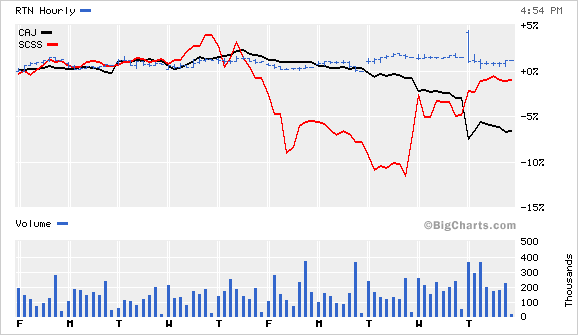
Select Comfort, Canon and Raytheon all reported earnings this week. I don't have a fundamentally different view of any of the companies, but it seems the market reacted fairly strongly.
Wednesday, July 27, 2005
Fear of uncertainty
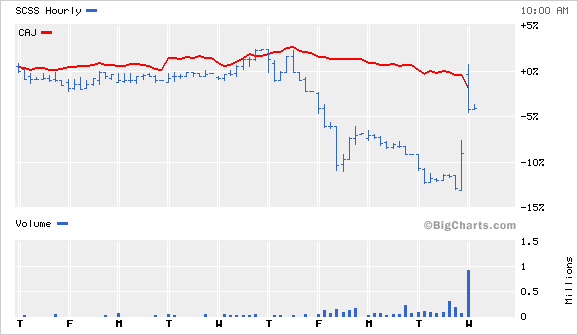
Looks like investors of Select Comfort were nervous about the possibility of an earnings disappointment. It would have been a great time to buy. Meanwhile, Canon also reported earnings last night and it's stock price barely budged.
Monday, July 25, 2005
GE mentality
Joel Spolsky just wrote an article about how software companies make money. Basically, since there is no incremental cost to shipping more software, only the top supplier of a certain type of software can survive. If you aren't number one, you can't sell enough to make back the costs of hiring a bunch of developers to create your product.
That's why it's so encouraging to me that Oracle's Larry Ellison has embraced the GE mentality: "the belief that businesses must be, or become, number one or number two in their marketplaces." Oracle already has the number one possition in database, but they needed to buy PeopleSoft in order to remain or become number two in certain applications.
Subscribe to:
Posts (Atom)


