Showing posts with label SGOIX. Show all posts

Monday, October 06, 2008

Wait 'til next year!

A little over year ago, I posted a list of mutual funds in my portfolio as if they were a baseball team. In that time, the markets have been rocked and it seemed like a good time to review their performances. The statistics (5-year return/expense ratio/turnover ratio) have been updated to include the most recent numbers I can find for them. I'm also commenting on "last-year's season", which I define as 1-year return from October 3. Today's market was way down, so I expect performance to be a bit worse for these funds. My benchmark is -27%, which about what the market has lost over the same period. Brutal.

  1. First Eagle Overseas - 11.59/0.88/34 (CF)
  2. -18.82% — For a fund that has been heavily invested in gold, losing double digits seems pretty bad. Maybe Jean-Marie Eveillard inherited some bad positions. Maybe, like most of us these days, he had a few positions blow up. In any case, the fund deserved its lead-off spot as it beat the S&P 500 and all but one of its teammates.
  3. T. Rowe Price Small-Cap Stock - 4.61/0.71/40 (SS)
  4. -26.46% — At almost exactly league average, OTCFX does not look good and hasn't for a long time. On the other hand, I suspect the environment will turn around as more good companies get beaten down with the bad. For the moment, I'm hanging on, but a lineup change may be coming soon.
  5. Vanguard PRIMECAP - 7.27/0.31/11 (1B)
  6. -20.04% — At 7% better than average, PRIMECAP continues to be a solid performer.
  7. Dodge & Cox International Stock - 10.94/0.65/16 (RF)
  8. -32.89% — At 6% less than the market, my prediction that the fund might be too big for its britches seems to have been correct. As a result, I'm demoting it to a 5% position and considering cutting it altogether.
  9. Oakmark Global - 8.26/1.13/35 (LF)
  10. -26.94% — Oakmark Global has held its own with almost exactly market returns over the last 12 months. Since the US has done better than other countries in this market(!), that's good for a global fund. If the fee were lower, it might well be a 10% position for me.
  11. Raytheon - 16.10/0.00/0 (DH)
  12. -14.4% — Raytheon has done well recently as it collects more government contracts. I continue to pay only slight attention to this position, but I suspect government spending will shift away from defense in the coming years. Hopefully, Raytheon will find a way to follow the money or build more civilian products.
  13. S&P 500 Index - 3.24/0.01/4 & PIMCO Total Return - 4.66/0.43/226 (C)
  14. -27.07% —
    4.49% — Thankfully, the PIMCO fund has been in the lineup this year so I get a modest positive return rather than the dreadful negative return. Fortunately, I've allowed this position to grow to 25% of my account. As of tomorrow after the close, I will have sold some of this portion to rebalance the lineup. I'll be favoring funds that have performed well over the last 12 months and that I have confidence in.

    The next question is: has the market fallen far enough to shift from bonds back to stocks? As I noted when I originally bought the fund, the inverted yield curve was my primary reason for switching to bonds. Conditions have been turning to start favoring stocks, but it's taken most of the year. I anticipate switching shortly after the Federal Reserve meets again to lower rates at the end of the month.

  15. Turner Emerging Growth - 8.54/1.55/88 (2B)
  16. -25.81% — I haven't expected much from this fund and I haven't been disappointed. The return has been only a little better than average, but that makes it one of my better positions this year.
  17. Fidelity Equity-Income - 2.57/0.67/24 (3B)
  18. -33.40% — I don't plan to add money to Fidelity Equity-Income unless and until there is some compelling reason to do so. Underperforming by 6% or so, is not compelling.
  19. Columbia Value & Restructuring - 5.36/0.94/11 (P)
  20. -34.37% — Excelsior Value & Restructuring has been renamed to Columbia Value & Restructuring, but it has the same management and structure. In a recent interview manager Dave Williams suggested that some restructuring situations take five or more years to develop. I'd hoped that this fund would be counter-cyclical, but it seems to have suffered from fewer buy-outs and mergers in the last 6 months or so.

-19.9% — My fund team has not performed as well as I'd hoped during the downturn in the market, but better than the market as a whole. PIMCO Total Return was the hero of the group as might be expected. Among the stock funds, First Eagle Overseas and Vanguard PRIMECAP earned their high spots in the batting order. Next year, I hope to report the S&P 500 anchoring a strong lineup of stock funds to make back some of this year's losses.

Monday, August 06, 2007

FundAdvice.com's advice about my funds

FundAdvice.com publishes advice on various 401(k) plans, including the one at Raytheon. A striking aspect of the suggestions is how few funds they picked—especially for the "Aggressive" portfolio. My comments on the funds I didn't pick:

  • Vanguard Windsor - 15.18/0.25/38
  • If Vanguard PRIMECAP was not offered in the Raytheon plan, Windsor would likely take its place. Compared to its Vanguard brother, Windsor has slightly underperformed with lower expenses and higher turnover. I suppose I have slightly more confidence in PRIMECAP compared to Wellington management.
  • American Century Small Cap Value - 15.89/1.05/121
  • The analogous funds I own are T. Rowe Price Small-Cap Stock and Turner Emerging Growth. American Century combines the lower performance of the former and the high expenses and turnover of the later. It's hard to get excited about that combination. Small company funds are a definite weak point of the Raytheon plan.
  • Real Estate Securities Fund - 27.55/?/?
  • This fund is a specialty REIT fund that entered the Raytheon plan on 01/01/2003, which is also the start date for the "5-year return" listed above. We have almost no other information, including expenses and turnover. The top holdings don't mean very much to me and I'm not terribly excited about adding Real Estate exposure at the moment.
  • BGI EAFE Equity Index - 20.37/0.10/7
  • I like index funds, but I already have three actively managed funds that I think do a better job than this index. The unbeatable thing about index funds is their low turnover and fees, and consistently average returns. Foreign stock funds are better candidates for actively managed funds that have the ability to out-perform the benchmark.
  • Stable Value Fixed Income - 5.09/?/?
  • I'm going to assume this is the same fund that is now called the Fixed Income fund. If not, my comments would likely still apply. Recently PIMCO made some bad guesses about the bond market that have cost investors a bit of return lately. But each month (roughly) we hear the thoughts of Bill Gross, the Total Return fund's manager. In contrast, there is nearly no information about the Fixed Income fund, which is only found in the Raytheon plan. A bond fund for me serves as a piece of a market timing strategy in which I try to avoid market losses by holding relatively stable bonds. The yield I earn in times of market risk, such as at the moment, is purely a bonus as far as I'm concerned.

I have also put into place a fund allocation scheme that I think I can follow. With 10 funds, each would have a 10% or so share in my portfolio if I were equally comfortable with their prospects. But some funds (Excelsior Value & Restructuring, Vanguard PRIMECAP, and First Eagle Overseas) deserve an extra share (15%) since they seem better bets than the others. In order to make rooms, those funds are paired with funds (Turner Emerging Growth, Fidelity Equity-Income, and Oakmark Global) that I don't have as much confidence in which will receive a half share (5%). If I were to gain greater confidence in a fund (perhaps Value & Restructuring), I could assign it a double share (20%) and pair it with either two half-share funds or eliminate a position altogether.

Note that this allocation doesn't exactly match the "batting order" I presented last week, even if the pitcher spot is given a greater role based on defense. Diversification with my IRA holdings knocks down the value of owning Oakmark Global. I'm not happy with the small company choices Raytheon offers, including the T. Rowe Price Small-Cap Stock, and that segment is well-represented in my IRA.

I've also designated PIMCO Total Return as my "gateway fund". It receives all deposits initially and diverts them to funds that are getting underweight. I had planned on using another fund for this purpose, but I just learned that the redemption fee for short-term trading is no longer going to be charged.

Thursday, August 02, 2007

Ten little mutual funds

It's been a very long time since I looked at my 401(K) options. I have a hard time talking about these funds because there isn't a lot going on with them. Unlike a stock like Canon which has more news each week than I could possibly comment on, mutual funds barely look different from one year to the next. So I thought it might be fun to look at the 10 funds I currently hold as if they were a baseball lineup. The statistics are 5-year return/expense ratio/turnover ratio. Higher is better for return (obviously) and lower is better for the other two. The lineup (with the exception of the pitcher spot) is roughly the order I feel comfortable with these funds in the future. Overseas funds belong in the outfield, small-cap funds are middle infielders, large-cap funds play corner infield, index and bond funds play catcher, and the special-situation fund is pitcher.

  1. First Eagle Overseas - 23.04/0.89/28 (CF)
  2. Jean-Marie Eveillard is once again the manager of this wide-ranging fund. He recently replaced Charles de Vaulx, who left for some reason I've never found out, but he'd had 26 years managing the fund before his premature retirement. Currently the fund is most heavily invested in cash and gold, so it ought to be able to invest in bargains as the markets head south. Some of the bigger holdings are international brands such as Nestle, Toyota, Shimano, and L'Oreal, but many more or obscure to me at least. In many ways having a fund managed by a Frenchman is more diversifying than yet another New York or U.S. based fund.
  3. T. Rowe Price Small-Cap Stock - 15.71/0.91/20 (SS)
  4. Gregory A. McCrickard has led this fund for 15 years. The five year return looks good until you compare it to the small-cap stock universe or the funds in this category. Both sport returns several percentage points higher. Unfortunately, there aren't a lot of choices for investing in small companies offered by my 401(k) plan. Small-cap investing ought to be where active management shines, so I'd like to get at least one fund in the mix even if it isn't the best in category. Both the management fee and turnover signal that the T. Rowe Price fund is a better bet than the Turner fund listed below.
  5. Vanguard PRIMECAP - 17.53/0.31/10 (1B)
  6. PRIMECAP is managed by a company of the same name based in Pasadena. Howard B. Schow, one of six credited managers, gets a cameo in the most recent revision of The Intelligent Investor discussing the idea that management ought to be held accountable for the goals they establish for themselves. It's not a good sign when a manager talks up margins until they start to contract and talks about sales growth instead. I like this fund both for its exceptional performance, but also for its very low expenses and turnover. Among its top holdings are Oracle, Adobe, FedEx, Microsoft, Sony, and Potash Corporation of Saskatchewan, Inc. There are a lot of good ideas in there, but I wish I knew more about how the companies are picked.
  7. Dodge & Cox International Stock - 24.72/0.66/9 (RF)
  8. This fund is managed by a team, which ought to help when allocating the fund's large and growing asset-base. One fairly recent addition to the portfolio is a Norwegian energy and aluminum company called Norsk Hydro ASA. There are also names like Nokia, Honda, News Corp., Shell, Bayer, and Volvo that most Americans will know. The fund seems to be widely recommended and has done exceptionally well, so it runs the risk of growing larger than its ideas. Thankfully the expense and turnover ratios bode well for the future.
  9. Oakmark Global - 22.44/1.18/41 (LF)
  10. Clyde S. McGregor has managed Oakmark Global for most of the last five years and added Robert A. Taylor as a co-manager two years ago. International funds have been a particularly easy category to make money in recently, so I have some concern this team is not as good as its record. But it is a very good record and I suspect that global funds will continue to outperform their more limited brethren. The expense ratio is pretty high, but since this is a newer fund it might creep down in time. Also, I'm happy to continue paying for exceptional performance. Oracle is one of the fund's larger holdings which makes my overweighted position in the software company overweighteder as I add to the fund.
  11. Raytheon - 15.5/0.00/0 (DH)
  12. I no longer closely follow Raytheon, but from the inside we seem to be doing fairly well. A few years ago, we were allowed to diversify away from company stock in the company 401(k), which I take full advantage of. Despite raising the dividend recently, Raytheon's yield has dropped from 2.66% in 2004 to 1.82% today.
  13. S&P 500 Index - 10.73/0.01/4 & PIMCO Total Return - 4.84/0.43/257 (C)
  14. This platoon is my basic market timing experiment. The S&P 500 index fund is the cheapest way to participate in bull markets and PIMCO is a fairly safe place to earn bond yields when there is a bear market. I've been invested in the bond portion of this position for a year and a half based on an inverted yield curve. I've missed out on some nifty gains (though only in this position), but PIMCO Total Return and Raytheon are the only two investment that have not lost money over the last month. I don't plan to switch back to stocks until the yield curve returns to a more normal configuration.
  15. Turner Emerging Growth - 19.81/1.54/78 (2B)
  16. Frank L. Sustersic and William C. McVail are closing in on 10 years running this fund and Heather McMeekin was hired five years ago. Like the T. Rowe Price fund, I've focused on Emerging Growth in order to have small companies represented in my fund portfolio. Five-year return looks great, but the expenses and turnover are a concern. Cash represents 12% of fund assets at the moment and I don't recognize many of the stock holdings. Deckers Outdoor Corporation, which makes Teva sandals and Uggs boots, stands out as a large holding I recognize. Almost a quarter of the stocks my market value are industrial materials manufacturers according to Morningstar.
  17. Fidelity Equity-Income - 13.80/0.67/24 (3B)
  18. Equity-Income has been on my radar for a very long time, but it isn't terribly exciting so I haven't started building a position until recently. Stephen R. Petersen has served as manager of this fund for 14 years, so he can certainly take credit for its current record. The current yield is 1.56%, which doesn't seem particularly high for an "Income" fund. On the other hand, expenses are reasonable and the fund has outperformed the market since the peak of the internet bubble of 2000. I won't bore you with the names of the top investments because they are exactly what you would expect this sort of fund to own. I don't plan on letting this be a large part of my 401(k), but it seems a reasonably defensive choice.
  19. Excelsior Value & Restructuring - 19.18/0.84/13 (P)
  20. This fund is actually my favorite fund in the bunch which I saved until last because I don't know what to do with it. David J. Williams, the fund's manager for 15 years, has focused on companies that are experiencing some sort of shift either internally or within their industry. For instance, he bought Tyco after the story of its extravagant CEO brought down the price and continues to hold some of the companies that spun off Tyco earlier this year. He also invested in Deluxe Corp., which dominated the paper check business and is now struggling to find new sources of revenue. These deals don't always work out, but the fund's performance is pretty exceptional. I think if I were forced to pick just one fund to hold, it would be this one. Special situation investing can be more laborious and error-prone than simply buying big companies with good earnings, so I don't mind paying the very reasonable fees.

My favorite funds are those that open up the black box just enough for investors to take a peek inside. My 401(k) doesn't have many funds that are as open as Pimco has been over the years, so I need to search a bit more than I'd like to get to know the managers and their styles. Ten funds seems like a lot when compared to the more compact portfolio of my IRA and much of that is due to the sparse information available. I don't want to assign strict 10% allocations to these funds, since they vary in quality and likelihood to outperform. I think this post will help me sort out what the final allocation ought to be.

Friday, June 22, 2007

My first five years

As of today, I've been actively trading in my IRA for five years. It has been one of the better periods of time to be invested in the US stock market. Five years is a pretty standard span to measure performance, but I'll feel better about my record after looking at it from trough-to-trough not just trough-to-peak.

Here is my year-by-year performance updated to the market close today:

Date      S&P 500  Delta     IRA   Delta BRK A  S&P 500   NAV    BRK A
06/23/02                                         992.72 10.00  72,200.00
12/31/02   -11.37% 42.32%  30.95% 30.18%  0.76%  879.82 13.09  72,750.00
12/31/03    26.38% -1.49%  24.89%  9.08% 15.81% 1111.92 16.35  84,250.00
12/31/04     8.99% -2.16%   6.84%  2.49%  4.34% 1211.92 17.47  87,910.00
12/31/05     3.00%  3.23%   6.23%  5.42%  0.81% 1248.29 18.56  88,620.00
12/31/06    13.62% 14.88%  28.50%  4.39% 24.11% 1418.30 23.85 109,990.00
06/22/07     5.94% -1.58%   4.36%  6.35% -1.99% 1502.56 24.89 107,800.00
Total Gain  51.36% 97.54% 148.90% 99.59% 49.31%    
Annualized   8.64% 11.36%  20.01% 11.66%  8.35%    

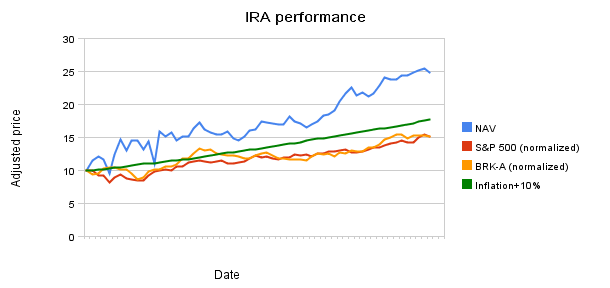
And here is the graphical version: IRA performance

The green line labeled "Inflation+10%" represents a benchmark suggested over at Controlled Greed. To measure inflation, I'm using the Bureau of Labor Statistics Series CUUR0000SA0. As you can see, that's a pretty tough benchmark to beat. I don't find it to be quite as helpful as the other two benchmarks I use. I'm beating it now, but what would I do if I weren't? With the index and Berkshire, I could decide after a few years of under performance to give up stock picking and just buy the benchmark. But I can't do that with inflation + 10%.

Update:

I took a quick look a the funds my 401(k) plan offers and the only ones that would have beaten my IRA's return over the last five years are First Eagle Overseas (20.91%) and Dodge & Cox International Stock (20.81%). I have positions in both funds, but I only started buying them recently. The performance difference is well within the margin of error, so there's no real incentive to switch even if I weren't having fun managing my own portfolio. Also, I have confidence in my own selections, but I don't have any particular insight into the stocks those funds are holding.

Thursday, June 21, 2007

Eveillard's tax device

I just came across an interview with Jean-Marie Eveillard, who manages one of my 401(k) mutual funds—First Eagle Overseas. There is one little answer that immediately caused me to open the spreadsheets of each of my core holdings.

Fortune: You pay a lot of attention to companies' tax rates. Why? Particularly in the U.S., I don't like companies with very low tax rates, because it's a sign either that the Internal Revenue Service will catch up with them someday or that the profits they report are overstated. The average corporate tax rate is 35%. Any company that has a tax rate of 15% or 20% looks suspicious to me.

This suggests a simple device for estimating how much risk a company has because of trying to game the tax system. Companies with overly low tax rates are like ticking time-bombs. There aren't a lot of positive reasons for a company to pay low taxes. The device also warns of companies that exploit the US system that allows companies to use two sets of books. Oracle has the highest rating and it isn't exactly a blaring fire alarm.

Company        Tax     Device     
-------        ---     ------
Oracle         29.71%   5.29%
Canon          34.52%   0.48%
Select Comfort 37.78%  -2.78%
Berkshire      32.81%   2.19%
Sally          38.82%  -3.82% 
Marblehead     38.51%  -3.51%

Raytheon       31.79%   3.21%